
AC Not Cooling Below 75? Why Your Unit Stops There
Your AC is probably not broken. In most East Bay homes, the unit hits 75 and stops because it is outworked, not because a compressor is dying. The fix depends on whether you are fighting a capacity problem or a refrigerant loss, and those two repairs cost very different amounts of money.
How to Tell If Your Unit Is Too Small for the Room
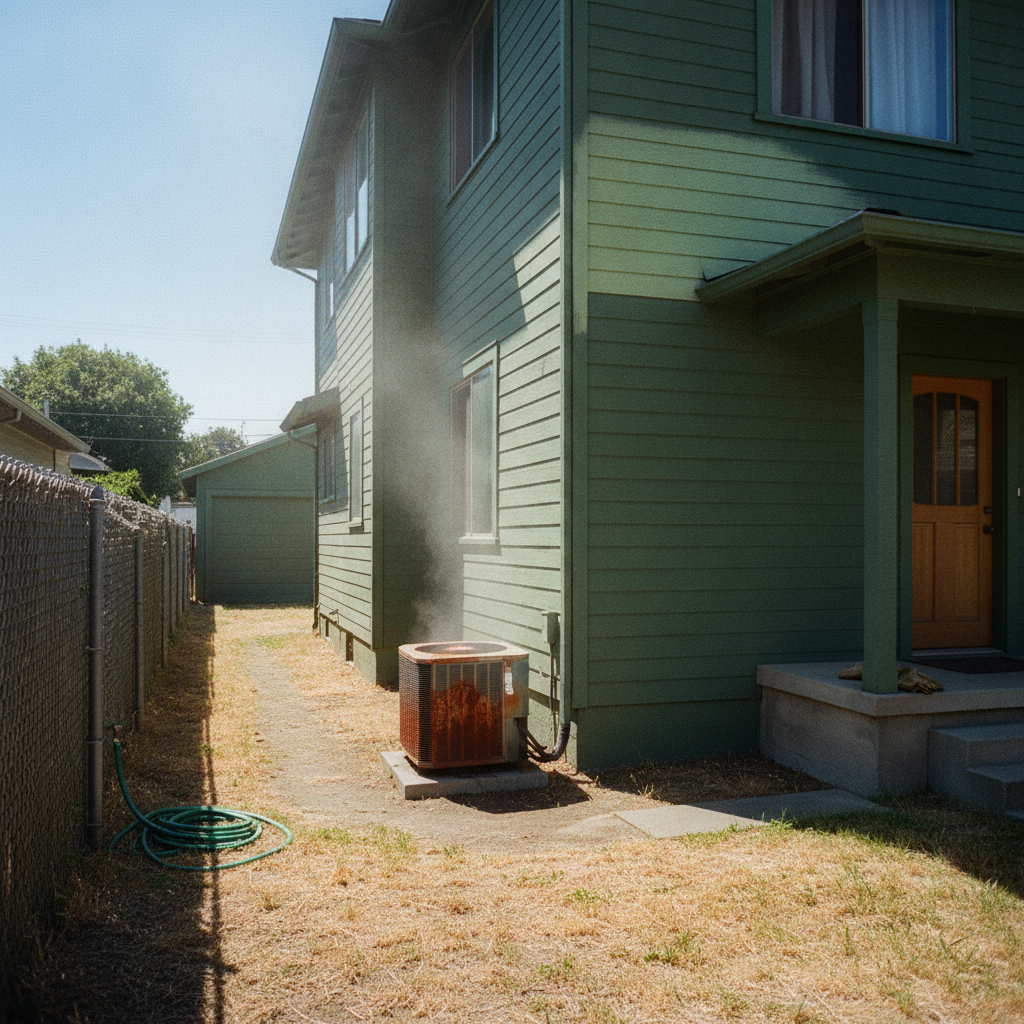
A 3-ton unit (36,000 BTU) in a 2,000-square-foot East Bay home will cap around 76 to 78 degrees on a 95-degree day. That is not a malfunction. That is the unit running at full output and losing the battle.
Check it yourself:
- Pull the access panel on the outdoor condenser. The tonnage is stamped on the data plate inside.
- Measure your conditioned square footage. Walk each room, multiply length by width, add them up.
- Divide total BTU by square footage. In the East Bay, you need roughly 20 to 25 BTU per square foot for a pre-2000 home with single-pane or early double-pane windows.
Below 20 BTU per square foot means the unit was undersized at install. It will never hit 72 in August. The compressor runs continuously, never cycles off, and the temperature plateaus at 75 or 76 no matter what you do.
What a Refrigerant Leak Does to Your Cooling
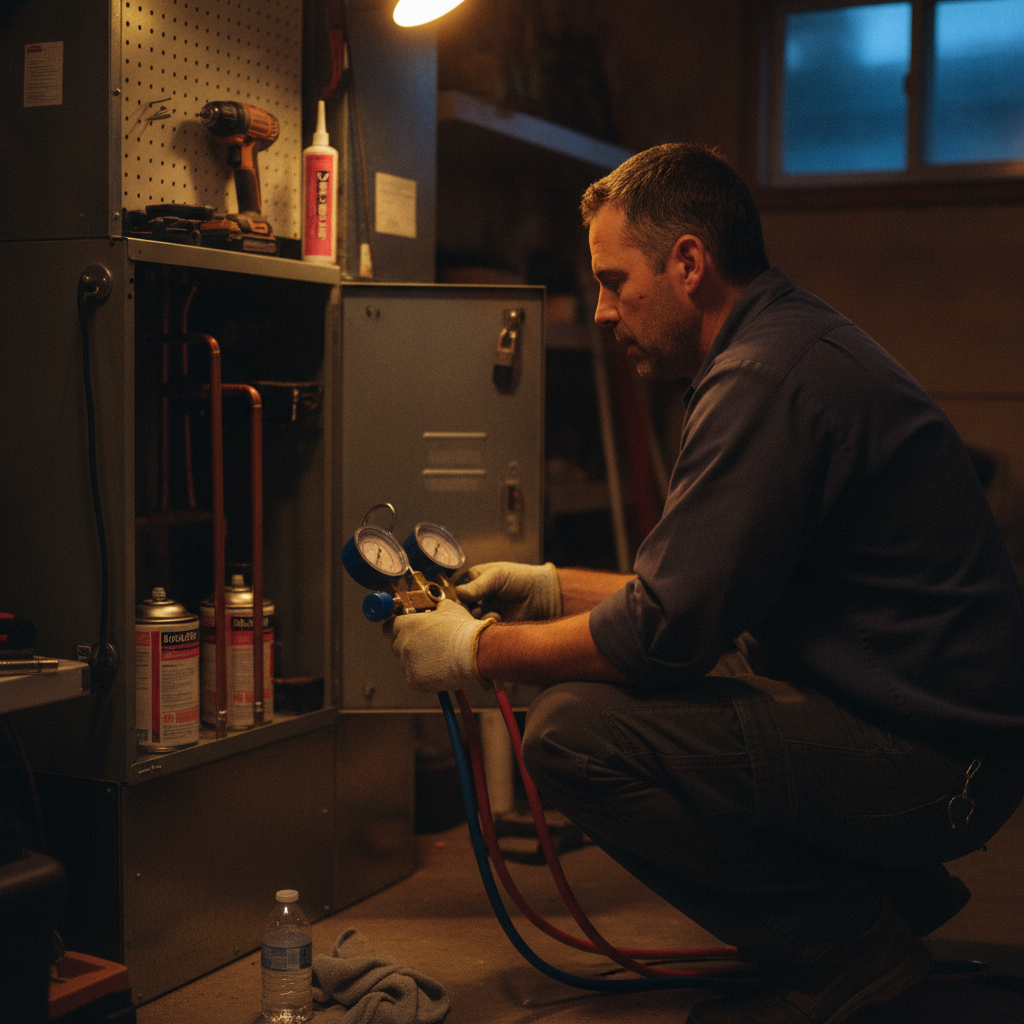
A partial refrigerant leak is the other reason your AC not cooling below 75 makes sense. The evaporator coil loses the ability to pull enough heat from the air, so the system drops 10 or 15 degrees and then stalls.
Signs it is a leak rather than a capacity issue:
- The unit hit 72 in the same heat wave a year ago, and now it stops at 75.
- The suction line (the bigger copper pipe on the outdoor unit) feels warm instead of cold.
- Ice forms on the evaporator coil after 20 to 30 minutes of runtime.
As of 2026, current refrigerants in new systems are R-32 and R-454B. The EPA cut off manufacturing of equipment above 700 GWP on January 1, 2025, which pushed the industry to those two. If your home runs R-410A, it is still legal to service. If it runs R-22, that refrigerant now costs $50 to $100 per pound and is getting harder to source.
A small leak (a few ounces over a season) is found with an electronic sniffer and a dye check. The repair is often a brazed joint or a replaced O-ring. A few hundred dollars, not a new system.
Is It Time to Replace or Just Fix It?
The honest answer comes down to two numbers: system age and repair cost relative to remaining life.
A repair under 30% of a new system’s installed price is usually worth doing on a unit under 12 years old. A compressor replacement on a 15-year-old R-22 system is different math. You are spending $3,000 to $5,000 on a part that will need the same refrigerant at $50 to $100 a pound for the rest of its life.
For a mid-sized East Bay home (1,500 to 2,200 square feet), a new 3-ton SEER2 unit installed runs roughly $5,500 to $8,000 depending on whether you need new ductwork or just a swap. SEER2 regulations have been in full effect since January 2023, and the minimum for our region is 14 SEER2. A 14 SEER2 unit in a San Leandro summer will pull your electric bill down compared to a 10 SEER unit from 2005.
Real Tonnage Numbers for a Mid-Sized East Bay Home

Most homes in San Leandro, Hayward, and the surrounding valleys were built in the 1950s through the 1980s with 2-ton or 2.5-ton units. That was fine when the homes were smaller and the windows were single-pane. But if you added a room, opened up a kitchen, or the original 2-ton unit is now the only thing cooling 1,800 square feet, it is going to struggle.
Tonnage for our climate:
- 1,200 to 1,500 sq ft: 2.5 tons (30,000 BTU)
- 1,500 to 2,000 sq ft: 3 tons (36,000 BTU)
- 2,000 to 2,500 sq ft: 3.5 to 4 tons (42,000 to 48,000 BTU)
These assume standard construction. A two-story home with brutal west-facing afternoon sun needs half a ton more. A proper Manual J load calculation accounts for all of that before anyone quotes you a number.
If your unit is the right size and still won’t go below 75, the problem is mechanical. Compressor wear, a failing fan motor, or a clogged condenser coil will all show up as a system that cools halfway and gives up. Those are repairable. The question is whether the system is 18 years old and you are about to spend $2,000 on a fan motor that will be followed by a compressor failure two summers later.
The first sign is almost never the last sign. If your AC not cooling below 75 is the first thing you notice, get it checked before the July heat hits 100 and the compressor gives out on a Tuesday when no one is available. That is when the “just fix it” answer stops being the cheap one.
Learn more about how Spot Free HVAC can help you.


