
AC Stopped Working? Repair vs. Replace Decision Guide
Your air conditioner stopped working and you’re Googling at 10pm wondering if someone’s about to talk you into a $15,000 system when a $400 capacitor fix would’ve done the trick. That fear is justified. The honest answer: most first-failure AC problems are repairable, and a legitimate replacement quote will show you the math line by line before you sign anything.
The 50% rule that actually works
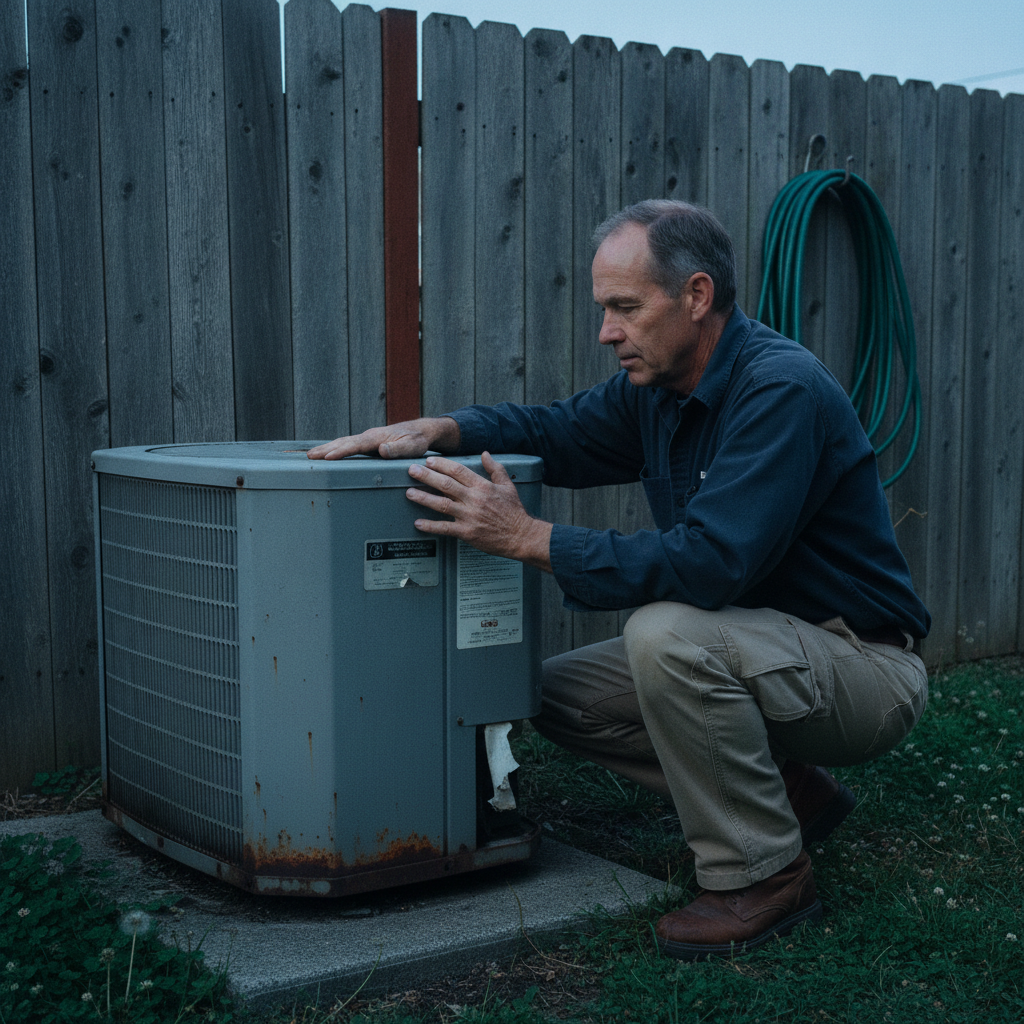
Here’s the math I run on every call. If the repair bill clears half the replacement price and the unit is past 10 years, you’re looking at a replacement. If the repair sits under that threshold or the unit is still in its prime, you fix it and move on. In the East Bay, a full central AC replacement runs $13,000 to $15,000 installed. So the 50% line lands between $6,500 and $7,500.
The rule breaks down like this:
- Repair under $6,500, unit under 10 years old: fix it.
- Repair over $7,500, unit over 12 years old: replace it.
- You’re in the middle (say, a $5,000 repair on an 11-year-old unit): fix it, but budget for replacement within two or three summers.
- Compressor is shot on a 15-year-old system: that’s your replacement window, full stop.
A $400 capacitor fix is not a $15,000 system. If the tech can point at the part, show you it’s cracked or corroded, and quote the repair in under ten minutes, you’re fine.
What a fair East Bay replacement quote looks like

You should be able to read the document and know exactly what you’re paying for without calling back to ask questions. A transparent quote at the $13-15k range lists every line in plain English:
- Equipment: brand, model number, SEER2 rating, and whether it’s a matched set (condenser plus evaporator coil) or just the outdoor unit.
- Labor: flat rate for install, with a separate line for electrical work if your panel needs an upgrade.
- Refrigerant: type (R-410A or R-32), amount in pounds, and the charge.
- Disposal and haul-away of the old unit.
- Permits and city inspection fees (Oakland, Berkeley, and Alameda all charge different amounts).
- Total, with a capped line for “additional work discovered during install” so surprises have a ceiling.
If the quote is one number on a napkin, walk away. You’re not obligated to sign on the spot. A straight shooter hands you the paper and says, “Take a night. Call your neighbor who had a system done last year. Get back to me.”
How do you know a tech is pushing replacement instead of fixing the problem?

The fastest tell is whether they’ll show you the broken part before talking about a new system.
If the tech opens the panel, points at the capacitor, and says, “See this? It’s blown. That’s a $380 part and 40 minutes of labor,” you’re getting a repair. If they open the panel, glance at it, close the panel, and say, “Honestly, at this point I’d just replace the whole thing,” that’s a sales conversation dressed up as a diagnosis.
Red flags to watch for:
- They won’t let you see the failed component or won’t explain what’s actually broken.
- The quote appears before any diagnosis is complete.
- They say “the system is at the end of its life” without checking the age or pulling maintenance records.
- They pressure you with “today only” pricing or a special that expires at 5pm.
- The quote doesn’t itemize. It’s one number.
Ask this and watch their reaction: “Can you show me the part that failed and tell me what it costs to replace just that part?” A legitimate tech says yes and pulls it out. A salesperson gets vague, mentions “efficiency losses” and “future failures,” and steers back to the full system.
SEER2 and why your quote should mention it
As of January 1, 2023, the Department of Energy requires every new HVAC unit sold in the U.S. to carry a SEER2 certification, with a 1% efficiency bump for northern and southern regions. The unit in your quote should list a SEER2 number, not the old SEER rating. If a tech quotes you a “20 SEER” unit in 2025, ask what the SEER2 equivalent is. The testing methodology changed, and the numbers shifted.
This matters in two ways. First, it affects your bottom line. A 16 SEER2 unit costs more upfront than the old 16 SEER unit did, but it pulls less power on a July afternoon when the East Bay sits at 94. Second, it’s a verification tool. If the quote doesn’t reference SEER2, the tech is either working from old inventory specs or isn’t current on the regulations. Either way, ask.
Your AC quit on you, you get a diagnosis, you get a number, and you decide. Nobody owes you a decision by end of day. The right tech respects that. The wrong one makes you feel like you’re losing a deal by not signing today.
Learn more about how Spot Free HVAC can help you.


